
The Difference Between Using AI and Building With It
A Tech Talk

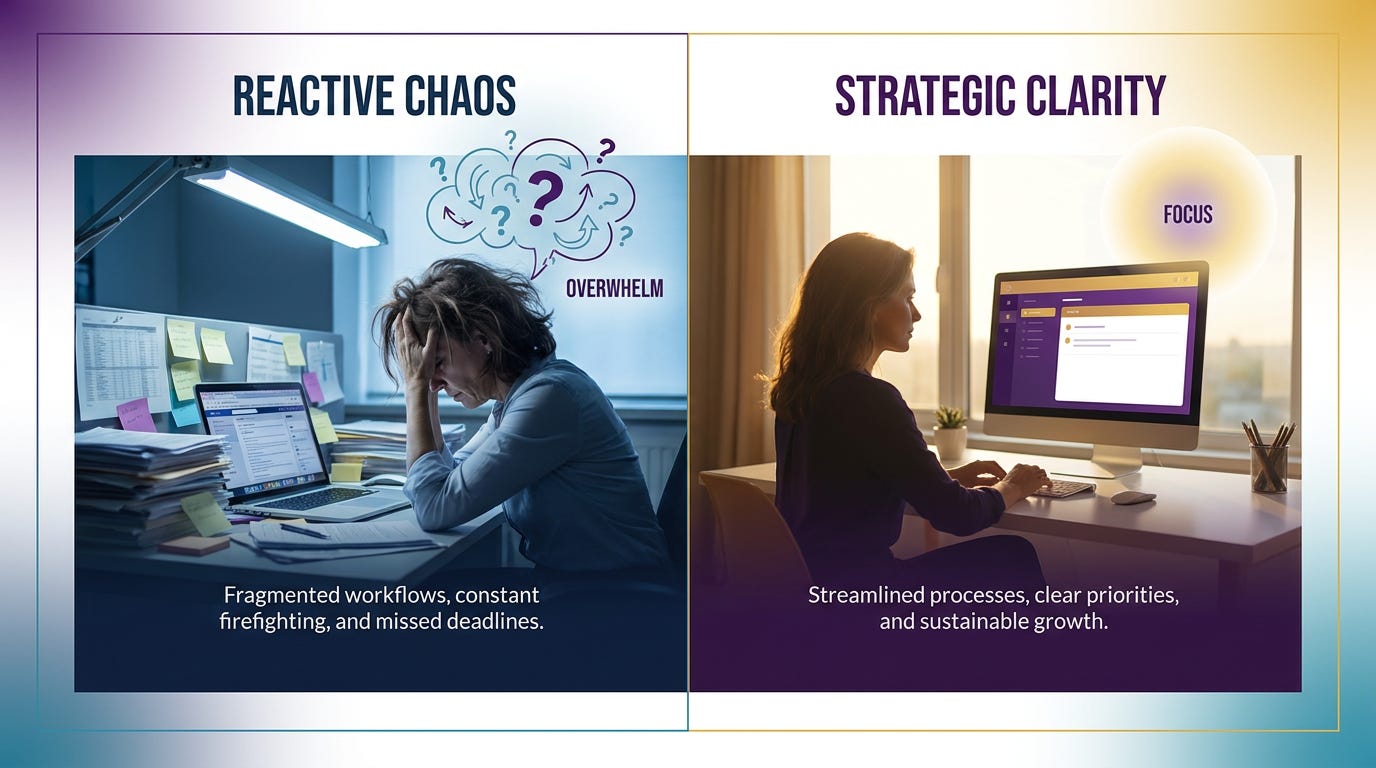
You’ve spent two hours with Claude trying to generate a week of LinkedIn posts. You got something usable. You published it. Nobody noticed. And you’re starting to think AI isn’t actually for you.
I get it. The promise is that AI will handle the content friction. And technically it did. You got output. But the output moved nothing in your business. So you’re sitting with the feeling that everyone else knows something about AI that you don’t, and you’re missing the boat.
Here’s what I think is actually happening: you’re using AI instead of building with it. Those are two completely different things.
Using AI vs. Building With It
Using AI looks like this: You ask ChatGPT for something. It gives you something. You take it or modify it slightly. You move on. It’s reactive. It’s useful for small things. It’s what most accomplished women do with AI, and it’s why most accomplished women feel like AI isn’t actually for their business.
Building with AI looks different. It’s not about asking the tool for an output. It’s about understanding exactly where friction lives in your specific workflow — the part of your business that slows you down or feels disconnected from everything else — and using AI to remove that friction. Not to replace the thinking. To remove the friction around the thinking.
The difference is subtle and consequential.
Most accomplished women default to “using” because it’s the easiest entry point. You already know how to ask questions. You can paste prompts. You can get output. Done. But that’s why the output feels generic. It wasn’t built for you. It was generated by a template.
What Building Actually Looks Like
Here’s a real example from my own business.
I have client calls. Every call has wisdom in it. Specific frameworks, specific moments where I named something a client had never heard named before, specific examples of what’s working and what isn’t. That’s intellectual property. But by the time the call ends, I’m on to the next thing. The wisdom sits in a recording in my files.
For three years I did what most people do: nothing. Or I tried to manually transcribe key moments. It was slow and I kept abandoning it.
Then I started building with AI differently. Here’s the workflow:
Record the call (already happening).
Send the recording to Claude with a specific prompt: “extract the three biggest insights, pull any frameworks I mentioned, find the specific examples that landed, give me the exact moment where the client shifted.”
Claude gives me back the substance. (I don’t get “advice about positioning” — I get the actual positioning conversation I had, cleaned up.)
Then I take that and in 30 minutes I can turn one hour of client call into a week of assets: a Substack article, three LinkedIn posts, an email, a community teaching. All in my voice.
Because it started with my actual work, not a template.
That’s building with AI. Not “use AI to create content.” But “use AI to extract the substance from the thinking I’m already doing and help me distribute it without sounding like a template.”
The AI is the friction remover. It’s not the hero. It’s the connective tissue between one hour of good thinking and a week’s worth of visibility.
Why This Matters: The VIOS Layer
I talk about this in the Visibility Infrastructure OS as Module 3.
Module 1 is inner clarity — positioning, knowing exactly who you serve and why you’re the only one who does what you do.
Module 2 is outer infrastructure — the systems that make visibility happen consistently. LinkedIn structure, Substack as your IP home, an email list that’s organized, a community that’s functioning.
Module 3 is the AI leverage layer. It’s where you remove the friction between expertise and visibility. The workflow that takes your thinking and makes it visible across platforms without you sounding like a robot or spending ten hours a week creating content.
Most people try to solve Layer 3 first.
They think “if I can just get the AI piece right, everything else follows.” So they learn prompting. They test different tools. They try every framework. And nothing lands because they haven’t done the work on Modules/Layers 1 and 2.
If you haven’t clarified your positioning, AI can’t position you. It can only generate more confused content. If you don’t have infrastructure in place, AI can’t build it for you. It can only give you more content to push into the void.
That’s why the two hours with Claude felt like wasted time. You were trying to solve a positioning problem with a tool designed to handle workflow friction.
Three Specific Places AI Actually Moves Your Needle
Okay, now that we’ve cleared that up: here are the actual places AI removes friction for accomplished women building visibility infrastructure.
1. Recording → Transcribing → Extracting → Distributing
You’re already talking. Client calls, talks to teams, notes you dictate, moments of thinking out loud. You have expertise in audio format all the time. AI can take that and pull the substance out, clean it up, and make it distributable. This is the workflow that saved me the most time and generated the most recognizable content. One hour of real thinking turns into a week of assets.
2. Batch content creation from single source
Related but different: instead of creating content one post at a time, you create from one core piece of wisdom. One positioning insight → three LinkedIn posts + one Substack article + one community teaching. AI helps you see the angles and extract them quickly so you’re not rewriting the wheel every time.
3. Testing positioning angles at scale
This is the sneaky one. You have a hypothesis about who you serve and why they need you. But you’re not sure. AI can help you quickly prototype different positioning angles in different formats and see which one your audience actually responds to. Not guessing. Testing. In a week.
How to Actually Build With AI (Instead of Just Using It)
So if you want to stop using AI and start building with it, here’s the actual process.
Step 1: Map your workflow
Where are you wasting time? Where does expertise sit and not move? Where do you say “I should be sharing this but the friction is too high”? That’s where you build.
Step 2: Identify one place AI removes friction
Not everything at once. One thing. For me it was call recordings. For you it might be something different. But pick the thing that, if removed, would actually change the tempo of your business.
Step 3: Test it on your own business first
Before you build a system, make sure it works for you. Run your own call through it. See if the workflow actually produces what you wanted.
Step 4: Document what works and kill what doesn’t
You’ll iterate a few times. That’s normal. Write down what worked so you can repeat it. Kill the steps that don’t.
This takes maybe two weeks to get the rhythm right. Not months. Not years. Two weeks of building, then it’s just part of how you work.
The Permission You Actually Need
Here’s the big secret about AI: you don’t actually need to understand how AI works.
You don’t need to be good at prompting. You don’t need to attend a course on Claude or ChatGPT or any of it. (Although-you should totally attend my “CLaude Coding for Entrepreneurs who Mean Business” once it’s done - lol.)
What you need is clarity on what you want to build and where the friction lives. That clarity comes from Module 1 of VIOS. From understanding your positioning clearly enough that you know what thinking is worth distributing and where the bottleneck is.
That’s what VIOS Module 1 is actually for. It’s not a course on positioning. It’s a 90-minute process that gets you clear enough to see where the friction is and what’s worth building toward.
Everything else follows from that.
If you want to get clear on your specific friction points and build a workflow that works for you, VIOS is $97.
Or if you need more hands on guidance, I offer a 90 minutes session with the VIOS tool build in - yours to keep forever for $497.
Of you can join my Premium WTIC group (if you are a woman) for $97 a month, and VIOS is included.
You go through the process. You get a positioning statement. You get a 30-day content map. You get clarity on where AI can actually help you move things.
DM me if you are interested - or comment below.
And please please please please - restack this if you found it helpful
Or share it with a friend.
Hugs and Productivity!
Viv

Viveka von Rosen is an international speaker, bestselling author, business strategist, and LinkedIn authority. She works with accomplished women founders to position their expertise, build visible authority, and use LinkedIn, Substack, AI, and practical systems to grow income on their terms.