
LinkedIn's 360 Brew Algorithm Stopped Showing My Content to 30,000 Connections. Here's Exactly What Happened—and How I'm Fixing It.
A step-by-step breakdown of LinkedIn's 360Brew reasoning engine, why it punishes career pivoters, and the alignment framework I built to get my visibility back.

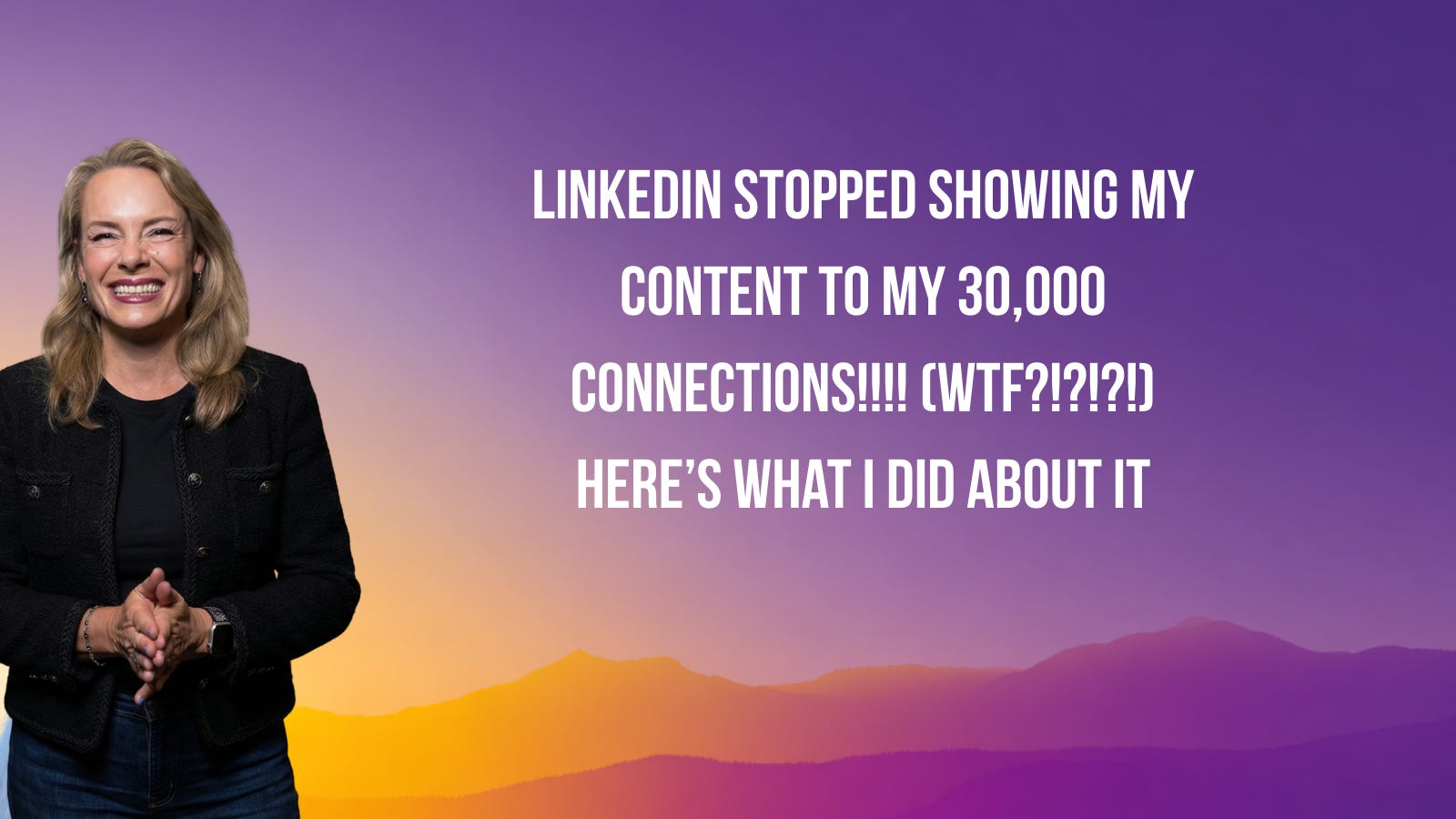
If you’ve noticed your LinkedIn engagement quietly dying over the past year, this post is for you.
I’m going to tell you exactly what happened to me—someone who spent almost 20 years as a recognized LinkedIn authority, who wrote four books on the platform, trained over 100,000 people, and built a business around it—when I made a major life and career pivot.
And then I’m going to give you the framework I’m using to fix it.
Because here’s what I’ve learned: the problem isn’t your content. It’s your alignment. And once you understand what LinkedIn’s new 360 Brew algorithm is actually looking for, you can change everything.
(PS - if you prefer video and have an extra 90 minutes on your hands, here’s the whole interview)👇🏻
The Day My LinkedIn Went Dark
It was March 2025.
I’d been posting consistently. My content was solid—better than solid, actually, because for the first time in years I was writing about things I genuinely cared about instead of churning out formulaic B2B marketing posts designed to drive traffic.
But my numbers told a brutal story:
30 - 50 views per post (down from thousands)
2 to 5 comments (rather than 20)
Engagement that had cratered to a fraction of what I’d built over two decades
I had 30,000 LinkedIn connections. And LinkedIn had essentially stopped showing my content to any of them.
My first thought? The platform just hates older women.
I was wrong. The real answer was more nuanced, more structural, and—thankfully—more fixable.
I’m talking about this in The Second Act Summit - March 2-6
Before I go deeper, if you’re new here: I’m Viveka von Rosen. I spent nearly 20 years as a LinkedIn expert—writing books like LinkedIn Marketing: An Hour a Day, creating five LinkedIn Learning courses, speaking globally, and co-founding a productivity technology company called Vengreso. My work has been featured by Forbes, FastCompany, CNN, Inc, BuzzFeed, and Entrepreneur.
In 2023, I walked away from all of it.
There’s something about turning 50-plus that makes you realize your time is limited, and you don’t want to spend it doing things you don’t love. The B2B sales and marketing world I’d built my career in felt too tight, too small, and completely out of alignment with what I was meant to do.
So I pivoted into coaching women 50 and older—accomplished leaders and executives transitioning from corporate to entrepreneurship—to build legacy businesses that amplify their voices through technology while honoring their wisdom, intuition, and purpose.
The pivot felt right. But my LinkedIn? It was still telling the old story.
If you’re finding value in this kind of honest, practical content—where I share what’s actually working and what isn’t, without the fluff—I’d love to have you as a subscriber. I go deep here on Substack in ways I can’t anywhere else. Subscribe to Reinvention Reads & Tech Talks
What Is 360Brew and Why Should You Care?
Here’s what most people haven’t caught up to yet.
Sometime around March 2025, LinkedIn began rolling out a fundamentally new algorithm system. It wasn’t announced with a press release or a flashy product launch. People just started noticing their engagement shifting—some up, most down.
By October 2025, when Dennis Yu published his deep-dive article on it, the system had a name: 360Brew.
And it changes everything about how LinkedIn decides who sees your content.
The Old Algorithm vs. The New One
The old system was relatively straightforward. You posted something. LinkedIn looked at surface-level engagement signals—likes, comments, dwell time (how long someone spent reading your post). If those numbers were strong in the first hour or two, LinkedIn showed your post to more people.
It was essentially a popularity contest. And you could game it with tactics like engagement pods (groups of people who agree to like and comment on each other’s posts), provocative hooks, and high-volume posting.
The new system—360Brew—is an AI reasoning engine. It’s built on a massive open-source foundation model with over 150 billion parameters. Think of it not as one AI brain, but as a boardroom of specialized expert networks, each focused on a different dimension of the LinkedIn ecosystem.
LinkedIn took that foundation model and put it through what researchers describe as an intensive training process focused exclusively on LinkedIn’s proprietary data. We’re talking about trillions of tokens of information: member profiles, connection patterns, engagement histories, skills, job titles, companies, industries, and the relationships between all of them.
The result is an algorithm that doesn’t just count your likes. It reasons about coherence.
The Four-Point Coherence Check
Here’s what 360Brew evaluates before deciding whether to distribute your content:
1. Your Profile
Does your LinkedIn profile tell a clear, coherent story? Is there one identifiable audience? One clear offer or area of expertise? Does everything—your headline, your About section, your experience, your featured content—support that single narrative?
2. Your Network
Who are your first-level connections? Are they the same people your content is designed to serve? Or are they leftover connections from a career chapter that ended five years ago?
3. Your Engagement Patterns
Who are you engaging with? What content are you commenting on, saving, and sharing? Does your engagement activity match the story your profile tells?
4. Your Content
Does what you post align with your profile, your network, and your engagement? Is there a consistent through-line?
If all four elements tell the same story, 360Brew rewards you with distribution. Your content goes out to your network, and potentially beyond it.
If they don’t align? 360Brew has no reason to show your content to anyone. Because it can’t figure out who would care.
Why This Hits Career Pivoters Hardest
Now here’s where this gets personal—and where it matters most for women like us.
If you’ve had a long, multi-chapter career (and if you’re a woman over 50, of course you have), your LinkedIn profile is almost certainly telling a fragmented story. You’ve done this, and that, and this other thing, and maybe started a business, and went back to corporate, and then pivoted again.
That’s not a weakness. That’s a rich, accomplished life. But 360Brew doesn’t see nuance. It sees incoherence.
Here’s exactly what happened with my four alignment points:
My Profile Was a Mess
After my pivot in 2023, my profile was all over the place. Twenty years of B2B sales and marketing content, LinkedIn expertise, tech company co-founding—layered on top of my new focus on coaching women 50-plus into legacy businesses. There was no single narrative. There was no clear audience. The algorithm looked at my profile and couldn’t find a coherent story.
My Network Was From Another Life
My 30,000 connections were almost entirely B2B professionals in sales and marketing. White dudes, mostly. Because that was my audience for 20 years and I’d been a proud “LinkedIn Open Networker” back when bigger was better.
But I wasn’t creating content for B2B sales professionals anymore. I was creating content for women over 50 in career transition. LinkedIn’s reasoning engine looked at my network, looked at my content, and said: Why would I show this to these people? They’re not going to care.
And it was right.
My Engagement Was Scattered
I was still engaging with old colleagues, old industry contacts, old content topics. My engagement patterns didn’t match my new direction.
My Content Was the Only Thing That Was Aligned
Ironically, the content itself—what I was actually writing and posting—was the one piece that reflected my new mission. But it didn’t matter, because the other three elements were so misaligned that 360Brew never gave my content a chance.
The Alignment Framework: What I’m Doing About It
I didn’t just diagnose the problem. I built a system to fix it—for myself and for the women I coach. Here’s the step-by-step breakdown.
Step 1: Align Your Profile to One Clear Story
This is where it starts. And for women with rich, multi-chapter careers, it’s the hardest part.
You have to make a choice. Not about who you were, but about who you are right now and who you’re building for right now.
What I did:
I rewrote my headline to speak directly to my current audience (women 50+ transitioning from corporate to entrepreneurship)
I restructured my About section around one offer and one transformation
I edited my Experience section to emphasize the through-line that connects my past to my present—rather than listing every role as if they were all equally current
I updated my Featured section to showcase only content relevant to my current work
What I built:
I actually created a custom GPT specifically to help me—and now my clients—build more coherent, aligned profiles. It walks you through each section and asks: Does this support your current audience and your current offer? If the answer is no, it helps you rewrite it.
(If you want my GPT - reach out to me for a $400 discount - it’s a part of my LinkedIn Legacy Program)
Your action step:
Open your LinkedIn profile right now. Read it as if you were a stranger. Ask yourself: Can I tell, within 10 seconds, who this person serves and what they help them achieve? If the answer is no—or if the answer is “it depends on which section I’m reading”—you have alignment work to do.
Step 2: Marie Kondo Your Network
This is the counterintuitive one. And it’s the one that makes people most uncomfortable.
I cut my connections from 30,000 to 20,000. And I still have about 10,000 more to remove.
I reduced my audience to increase my reach.
Here’s why it works: 360Brew evaluates who your connections are as a signal of who your content is for. If 80% of your network has nothing to do with your current work, the algorithm assumes your content isn’t relevant to most of your audience—because it literally isn’t relevant to most of your connections.
What I’m seeing with my clients:
Women with 2,000 tightly aligned connections are getting more engagement than I am with 20,000 mixed connections. Because LinkedIn’s reasoning engine looks at their network and says, “This makes sense. This content is relevant to these people. I’ll distribute it.”
A small, aligned audience beats a massive, irrelevant one. Every single time.
Your action step:
Start removing connections who are clearly from a different career chapter—people in industries you no longer serve, in roles that have nothing to do with your current work. You don’t have to do it all at once. Set a goal of removing 50 to 100 per week. And as you remove, start intentionally connecting with people who are your audience.
Step 3: Realign Your Engagement
360Brew doesn’t just watch what you post. It watches what you engage with.
If you’re still liking and commenting on content from your old industry, your old colleagues, your old professional world—you’re sending mixed signals. The algorithm can’t tell what you’re actually about.
What I changed:
I started spending 20 to 30 minutes around every post engaging intentionally with content from people in my current space—women entrepreneurs, career transition coaches, thought leaders in the 50-plus reinvention space
I stopped engaging with content just because the person was a friend from my old career (this was hard, and I still slip sometimes)
I started being more intentional about what I save, share, and comment on—because those are all signals
Your action step:
Before your next LinkedIn post, spend 15 minutes finding and engaging meaningfully with 3 to 5 posts from people in your current space. Not just a like. A real comment with a real insight or question. This primes the algorithm to associate your activity with the topics you’re about to post about.
Step 4: Audit Your Engagement Pods and Automation
This one stings for some people, but it matters.
If you’ve been using sharing pods—groups where everyone agrees to like and comment on each other’s posts—360Brew is likely picking up on that pattern. Especially automated pods. The algorithm can identify artificial engagement patterns, and it discounts them.
What I did:
I stopped participating in engagement pods entirely. The engagement I get now is smaller in volume but dramatically higher in quality—and 360Brew seems to reward that.
Step 5: Create Content That Completes the Circle
Once your profile, network, and engagement are aligned, your content becomes the final piece that closes the loop.
For me, this means every post I create ties back to one core narrative: empowering women 50-plus to build visible, technology-amplified legacy businesses.
I don’t post about B2B sales strategies anymore, even though I could. I don’t post generic LinkedIn tips, even though that’s what built my original audience. Every piece of content reinforces the same story that my profile tells, that my network reflects, and that my engagement supports.
Your action step:
Before you publish your next post, ask: Does this content serve the same audience that my profile describes? Would my ideal client find this valuable? Does it reinforce or dilute my narrative?
If it dilutes—save it for a different day or a different platform.
The Bias Problem: Why This Matters More for Women Over 50
I need to address something that’s been on my mind since I started understanding how 360Brew works.
This algorithm is AI. And AI is trained on data. And the data reflects the world as it currently exists.
Which means it reflects existing bias.
There is an enormous volume of LinkedIn content created by men. By younger professionals. By people in tech, finance, and sales. The training data is disproportionately shaped by those voices.
Women over 50—especially women who are pivoting, building new businesses, creating content about reinvention and legacy and purpose—are underrepresented in that data.
So the algorithm isn’t naturally calibrated for us. It doesn’t instinctively know how to categorize our content or who to show it to, because there’s less training data that looks and sounds like us.
This isn’t a reason to give up. It’s a reason to double down.
Every time one of us shows up with an aligned profile, a relevant network, and consistent, coherent content, we’re adding to the dataset. We’re training the system to recognize that women over 50 have audiences, that our content drives engagement, that our voices matter in the professional ecosystem.
We’re literally reshaping the algorithm by being visible.
That’s why I care so deeply about getting more women creating content. Not just for the individual visibility and business results—though those matter enormously—but because our collective presence changes what the algorithm learns to value.
What I’m Still Figuring Out
I want to be honest with you—because that’s what I do here on Substack, and it’s why I chose this platform for my deepest content.
My alignment work isn’t done. My profile is getting tighter every day, but it’s not yet where I want it. I still have about 10,000 connections to prune. My visibility has improved two to five times from its lowest point, but it’s not back to where it was in my LinkedIn-expert heyday.
And I’m okay with that.
Because here’s what I’ve discovered: I’d rather have 500 views from women who genuinely connect with my message than 5000 views from an audience that was never mine to begin with.
The numbers I’m chasing now are different. They’re not vanity metrics. They’re:
Inbound inquiries from women who say “I read your post and it felt like you were talking directly to me”
Substack subscribers who open every email (my open rate here is 50 to 60%, compared to 25% on my LinkedIn newsletter and 5% on my website newsletter)
Conversations that convert—not just to clients, but to real relationships with women doing meaningful work
Impact—watching the women I coach gain visibility, build confidence, and create businesses that matter
Those are the metrics that tell me the alignment is working.
The Format Question: Why LinkedIn Lives and Polls Still Work
One more practical note, because I know you’re wondering about format.
On LinkedIn right now, here’s what’s driving results for me:
LinkedIn Lives are still my strongest conversion format. The audience is tiny compared to what it used to be—tens of people instead of thousands. But those tens of people show up engaged, and the conversations that happen during and after Lives consistently lead to real business relationships.
Lives also give you a content cornerstone: you can repurpose clips into short-form video, pull quotes for posts, and write deeper breakdowns (like this one) from a single live session.
Polls drive my highest raw engagement numbers, but I use them sparingly. They tend to activate my existing audience rather than attract new people.
Saves are the new gold. 360Brew cares less about likes and basic comments than it used to. It cares about deeper signals—especially saves. When someone saves your post, the algorithm takes serious notice. So I create content worth bookmarking: frameworks, checklists, step-by-step breakdowns.
Newsletters still perform well for me. I have about 6,500 LinkedIn newsletter subscribers, and my open rates there (roughly 25%) are significantly better than my website newsletter. But my Substack—with a fraction of the subscriber count—gets the highest engagement of anything I publish.
Which brings me back to why I’m here, writing this, for you.
Why I Go Deepest on Substack
I want to tell you something about why I chose Substack over every other platform for my most important content.
I’m a writer. I always have been. And Substack was built for writers—not as a sales funnel platform that happens to allow content, but as a creative platform that happens to allow monetization.
The difference matters.
When I write here, I write the content I actually want to create. Not formulaic posts designed to game an algorithm. Not shortened, watered-down versions of bigger ideas. The full thing. The real thing.
I also love what Substack’s Notes feature does for growth. The short-form, social-style posts on Substack have introduced my work to people who would never have found me on LinkedIn—and those people tend to be readers, tend to be thoughtful, and tend to be exactly the kind of women I want in my community.
This platform attracts a self-selected audience of people who still value depth. And that audience skews older—because we’re readers. We grew up reading. We process the world through written words.
That’s my audience. That’s my medium. This is where I belong.
Where to Go From Here
If you’ve read this far, I already know something about you: you care about doing this right. You’re not looking for a hack or a shortcut. You want to understand why something works so you can make intelligent decisions about your own strategy.
That’s exactly the kind of woman I work with.
Here’s what I’d suggest as your immediate next steps:
This week:
Read your LinkedIn profile as a stranger would. Note every place where the narrative fragments or contradicts itself.
Identify 50 connections who are clearly from a past career chapter and remove them.
Spend 15 minutes engaging intentionally with content from people in your current space before your next post.
This month:
Rewrite your LinkedIn headline and About section to tell one clear story for one clear audience.
Set a weekly goal for network pruning (50 to 100 removals per week).
Start tracking not just your post views, but your saves and inbound conversations—those are the metrics that matter now.
If you want support:
I’m doing this work—the profile alignment, the network audits, the content strategy—inside The Women’s Technology Collaborative, my year long mastermind for women 50-plus building legacy businesses.
But we don’t just teach tech strategy. We address the stuff underneath it: the imposter syndrome that whispers you’re not enough, the fear of both failure and success, the paralysis of being stuck between who you were and who you’re becoming.
Because I can give you the perfect alignment framework, and if imposter syndrome is running the show, you won’t implement it. I’ve seen it happen too many times.
So we pair inner transformation—visualization, releasing limiting beliefs, building unshakeable confidence—with practical tech implementation that creates visible, trackable momentum.
I hold the vision of your success even when you can’t see it yourself. That’s not a tagline. That’s what I do, every day, for every woman I work with.
Learn more about The Women’s Technology Integration Collaborative →
One More Thing
I said earlier that I initially thought LinkedIn just hated older women. And while 360Brew isn’t specifically biased against us, the data it’s trained on is biased toward voices that don’t look or sound like ours.
That’s not going to change by itself.
It changes when we show up. Consistently. Coherently. Visibly.
Every aligned profile. Every piece of content that serves our true audience. Every connection we make with intention instead of volume. It all teaches the algorithm that women over 50 are here, we have something to say, and people want to hear it.
Women’s wisdom and words change the world. Technology makes sure the world hears them.
But only if the technology can find us. And now you know how to make sure it does.
Thank you for reading Reinvention Reads & Tech Talks. If this was valuable, here are three ways to keep going:
1. Share this post with a woman who’s been wondering why her LinkedIn went quiet after a career pivot. She’s not broken. Her alignment is.
2. Leave a comment below. I want to hear your experience: Have you noticed your LinkedIn engagement shifting? What’s your biggest challenge with the pivot from who you were to who you’re becoming? I read and respond to every comment.
3. Subscribe if you haven’t yet. I publish deep dives like this regularly—honest, practical, no fluff—and I’d love to have you in this community.
I continue to shed connections and followers and despite the opinions off SSI and the whole gamification of LinkedIn and networking, all indications point to an SSI 70 or above will help restore some of the reach and engagement.
I'm clawing my way back to the 70+ and can already see improved profile views, impressions, and new follower count from a more aligned community.
WHOA!!! Deleting contacts who are not aligned with my new mission is super scary, and I see why it's necessary. Off to Marie Kondo my LinkedIn now. Thanks, Viveka!